Access
Open from dawn until dusk.
Location
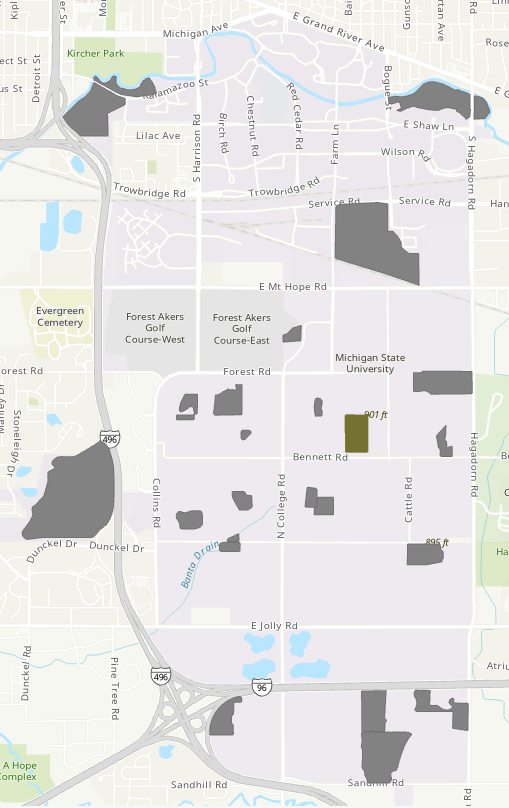
- Hudson Woodland Location Map
- South Campus, farms area, northwest of the intersection of Bennet Rd. and Beaumont Rd.
- Woodlot is surrounded with barbed wire fence that is either unstable or completely down in most places.
- Accessibility is limited due to the natural growth of vegetation and the terrain.
- Entrance Points - map
- There are no formal entrances.
Parking
- Contact: Tony Boughton, University Farms Manager; email: boughto3@msu.edu.
- Parking is very limited. Space for one or two vehicles at the southwest and northeast corners of the natural area.
Features
- Area: 20.5 acres
- Mixed-aged stand
- Drier north portion with many large old sugar maple, beech, red oak, and basswood trees.
- Northern portion also has very dense growth of even-aged young maples.
- Wetter south portion has white ash, red oak, shagbark hickory, bitternut hickory, and basswood.
- The rare herb Harbinger-of-spring is present on the northwest side of the woodland.
Publications & Reports
Cook, J. L. (2004). Disease, pollinator, and resource limitation influences on the reproductive biology and growing season of Arisaema triphyllum, Jack-in-the-Pulpit. Michigan State University.
Cubero, L. D. R., & Downtin, A. (2019). How Adjacent Land Use Affect the Deposition and Transport of Pollutants in Urban Forest?. MSU AGEP Science Today Bulletin Fall 2019, 6.
Dodge, S. L. (1984). Soil Texture, Glacial Sediments, and Woodlot Species Composition in Northeast Ingham County, Michigan (Biogeography, Plant Geography) (Doctoral dissertation, Michigan State University).
Flanders, R. A. (1971). Temporal associations among woodland plants in southern Michigan. Michigan State University. Department of Botany and Plant Pathology.
Higgins, M. J. (2000). Invertebrate trophic relationships in temporary woodland ponds in Michigan. Michigan State University.
Hudson Woodland Bio-inventory Report, August 2021
Husband, T. P. (1976). Energy metabolism and body composition of the fox squirrel. The Journal of Wildlife Management, 255-263.
Kaufman, M. G., Stanuszek, W. W., Brouhard, E. A., Knepper, R. G., & Walker, E. D. (2014). Establishment of Aedes japonicus japonicus and its colonization of container habitats in Michigan. Journal of Medical Entomology, 49(6), 1307-1317.
Morningstar, R. J. (2013). Mortality and development of Aedes larvae exposed to potential natural pathogens Aspergillus niger, Fusarium oxysporum, and Pythium ultimum. Michigan State University.
Peña, M. (2021). Hudson Woodland Bio-inventory Report. Michigan State University.
Reemts, C. M. (2005). Temperate deciduous forest fragments: edge effects, invasion by non-native plants, and long-term change in mature forest structure. Michigan State University.
Walker, E. D. (2016). Toxicity of sulfide and ammonium to Aedes triseriatus larvae (Diptera: Culicidae) in water-filled tree holes and tires. Journal of Medical Entomology, 53(3), 577-583.
Walker, E. D., Kaufman, M. G., & Merritt, R. W. (2010). An acute trophic cascade among microorganisms in the tree hole ecosystem following removal of omnivorous mosquito larvae. Community Ecology, 11(2), 171-178.
White, P. J., Glover, K., Stewart, J., & Rice, A. (2016). The technical and performance characteristics of a low-cost, simply constructed, black light moth trap. Journal of Insect Science, 16(1), 25.
Wonderlin, N., Ross, L. M., & White, P. (2017). Construction and performance of a novel capture-mark-release moth trap. The Great Lakes Entomologist, 50(1), 5.