Jump to HeaderJump to Main ContentJump to Footer
Michigan State University
  • Natural Areas List
  • |
  • Natural Areas Map
  • |
  • Contact
Campus Natural Areas
  • Natural Areas List
  • Natural Areas Map
  • Contact

< Natural Areas List

< Natural Areas Map

< Contact

Resources

  • Campus Maps
Michigan State University
Campus Natural Areas

Campus Natural Areas

Baker Woodlot & Rajendra Neotropical Migrant Bird Sanctuary

Photo Gallery
Campus Natural Areas > Natural Areas List >

Baker Woodlot

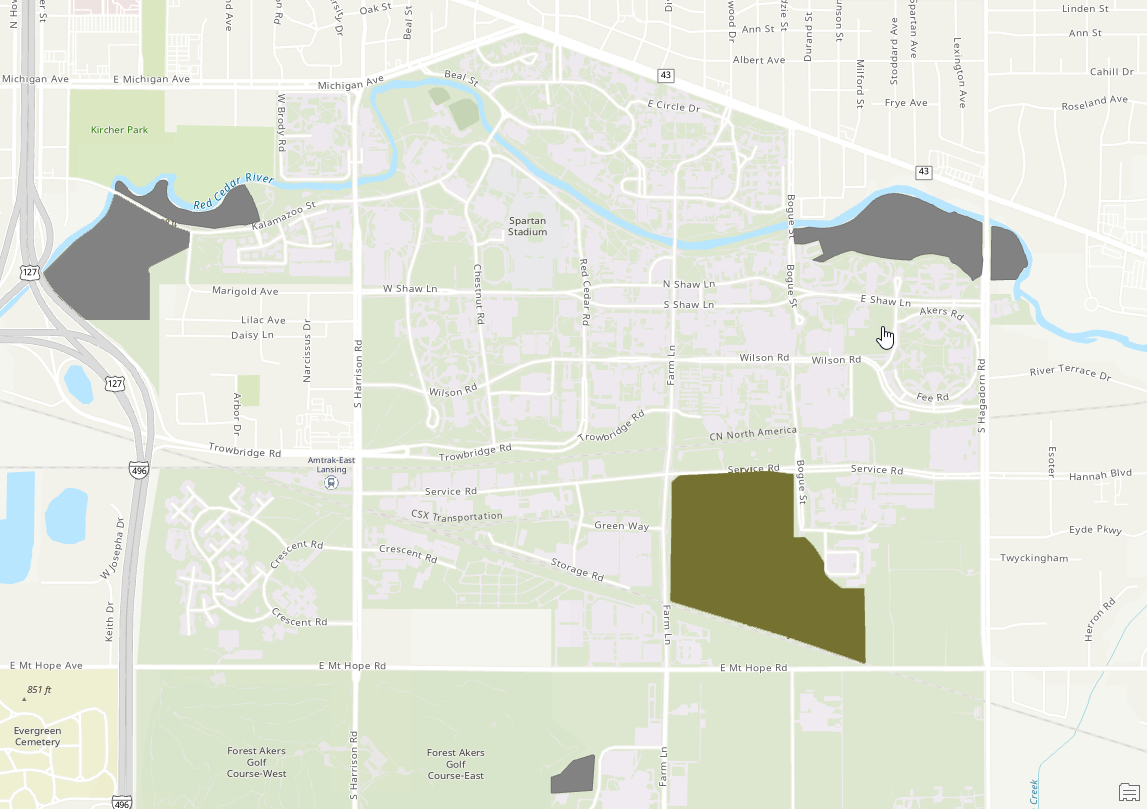
Baker Woodlot, Location Map

Baker Woodlot & Rachana Rajendra Neotropical Migrant Bird Sanctuary is a high quality, mesic forest covering 78 acres on MSU’s main campus.

Originally called South Woodlot, then Farm Lane Woodlot, it was eventually named Baker Woodlot in 1941 in honor of two early foresters at Michigan State, James Fred Baker and Harry Lee Baker. J. F. Baker was appointed Professor of Forestry and Chairman of the Forestry Department on 1 October 1907. Mr. H. L. Baker eventually became the first State Forester of Florida.

On 5 June 1999, a portion of the Baker Woodlot was designated as the Rachana Rajendra Neotropical Migrant Bird Sanctuary. Ms. Rajendra, a lover of birds and nature, was an MSU student. When a tragic automobile accident took her life in 1997, her family and friends established an endowment in her memory.

Access

Open from dawn until dusk.

Location

  • Baker Woodlot Location Map
  • Southeast corner of Farm Lane and Service Rd.
  • Woodlot surrounded by chain link fence.
  • Accessibility is limited at the entrance points due to ZigZag entrances and one gated entrance.
  • 4 Entrance Points
    • Entrance 1: ZigZag, Google Map
    • Entrance 2: ZigZag, Google Map
    • Entrance 3: ZigZag, Google Map
    • Entrance 4: ZigZag & Gate, Google Map

Parking

  • Public Parking: closest public parking is Parking Ramp 5 Trowbridge Rd. and Red Cedar Rd. with a walk east on Trowbridge Rd., South on Farm Lane to Entrance of Baker Woodlot.
  • Faculty/Staff Parking; east side of Baker Woodlot on Bogue St. Parking is restricted and signed for Faculty/Staff, Monday - Friday, 7:00am - 6:00pm

Features

  • Area: 78 acres
  • Overstory dominated by maple and beech, but there is a diverse array of woody and herbaceous species all across the woodlot.
  • Established trails are generally wide, clear, and a loamy soil surface with occasional sandy areas and intermittent exposed roots and rocks.
  • Characteristic of a beech-maple forest.
  • Ponds and ephemeral ponds.
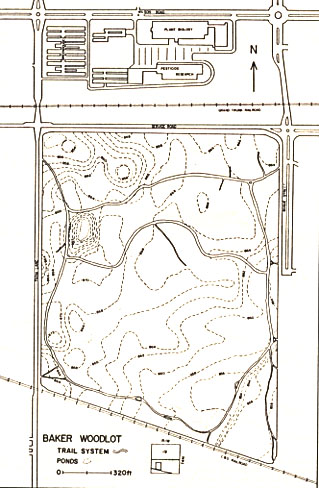
  • Trail Map of established trails.

    Baker Woodlot trail map


Publications & Reports

  • Beach, J.H. & W.D. Stevens. 1979.  A study of Baker Woodlot I.  Physical and historical description.  Michigan Botanist 18:123-136.
  • Beach, J.H. & W.D. Stevens. 1980.  A study of Baker Woodlot II. Description of vegetation.  Michigan Botanist 19:3-13.

  • Beach, J.H. & W.D. Stevens. 1980.  A study of Baker Woodlot III. Checklist of vascular plants. Michigan Botanist 19:169-136.

  • DeFrank, J., & Putnam, A. R. (1985). Weed Science Society of America. Weed Science, 33(2), 271-274.

  • Dodge, S. L. (1984). Soil Texture, Glacial Sediments, and Woodlot Species Composition in Northeast Ingham County, Michigan (Biogeography, Plant Geography) (Doctoral dissertation, Michigan State University).

  • Drew, L. C. (1957). The spider fauna of Baker Woodlot and vicinity, Michigan State University, including life histories. Michigan State University of Agriculture and Applied Science. Department of Zoology.

  • Fine, A. E., Bolin, C. A., Gardiner, J. C., & Kaneene, J. B. (2011). A study of the persistence of Mycobacterium bovis in the environment under natural weather conditions in Michigan, USA. Veterinary Medicine International, 2011.

  • Flanders, R. A. (1971). Temporal associations among woodland plants in southern Michigan. Michigan State University. Department of Botany and Plant Pathology.

  • Glendinning, Peter. 1979-1985. Baker Woodlot series.

  • Glendinning, Peter. 2016. Photography Capstone Project: Baker Woodlot Series: A failed plan but a successful ending.

  • Guerin, W. F., & Boyd, S. A. (1997). Bioavailability of naphthalene associated with natural and synthetic sorbents. Water Research, 31(6), 1504-1512.

  • Koch, R. A., & Herr, J. R. (2021). Transcriptomics Reveals the Putative Mycoparasitic Strategy of the Mushroom Entoloma abortivum on Species of the Mushroom Genus Armillaria. Msystems, 6(5), e00544-21.

  • Kolp, Matthew R., Chansler, Matthew T., Crow, Garrett E., Prather, Alan L. (15 July 2021). Declining Native Species Richness in Natural Areas in Eastern North America: An Example from Baker Woodlot in Central Michigan. Rhodora 122(991), 139-201.

  • Mestey-Villamil, V. M. (1986). Diplopoda of a Michigan Beech-Maple Forest: Population Ecology and Seasonal Activity (Millipede) (Doctoral dissertation, Michigan State University).

  • Morra, K., Mohr, C., Wolski, B., & Reh-Gingerich, A. (2014). Soil Pollution From Recycling Centers: Case Study Analysis from the Campus of Michigan State University. Inquiries Journal, 6(03).

  • Peña, M. (2021). Baker Woodlot Bio-inventory Report. Michigan State University.

  • Pielou, W. P. (1957). A Life-History Study of the Tufted Titmouse, Parus Bicolor, Linnaeus. Michigan State University.

  • Rudolph, V.J. & R.G. Bresnahan. 1982.  Twenty years of management in a small woodlot of Southern Michigan.  Journal of Forestry.  80:665-667.

  • Zak, D. R., & Pregitzer, K. S. (1988). Nitrate assimilation by herbaceous ground flora in late successional forests. The Journal of Ecology, 537-546.

Contact us

WJBeal@msu.edu on behalf of Campus Natural Areas

Address

Campus Natural Areas 408 W Circle Rd, Room 207 East Lansing, MI 48824

If you're having accessibility issues, please let us know.

  • Contact Information|
  • Site Map|
  • Privacy Statement|
  • Site Accessibility|
  • Call MSU: (517) 355-1855|
  • Visit: msu.edu|
  • Notice of Nondiscrimination|

SPARTANS WILL|© Michigan State University|